Perhaps the vision of the Moon was the first thing that pushed us to look at the stars. And despite all this time, we are unable to do well. Looking at the Moon approach the horizon see, apparently, increases its size. And scientists are still arguing which is the cause of this deception.
The first question to ask is whether this is an external effect, an illusion of some sort. There are several ways to check but one of the most striking is to use a picture with several exhibitions such as the following: ( Author & Copyright: Shay Stephens )
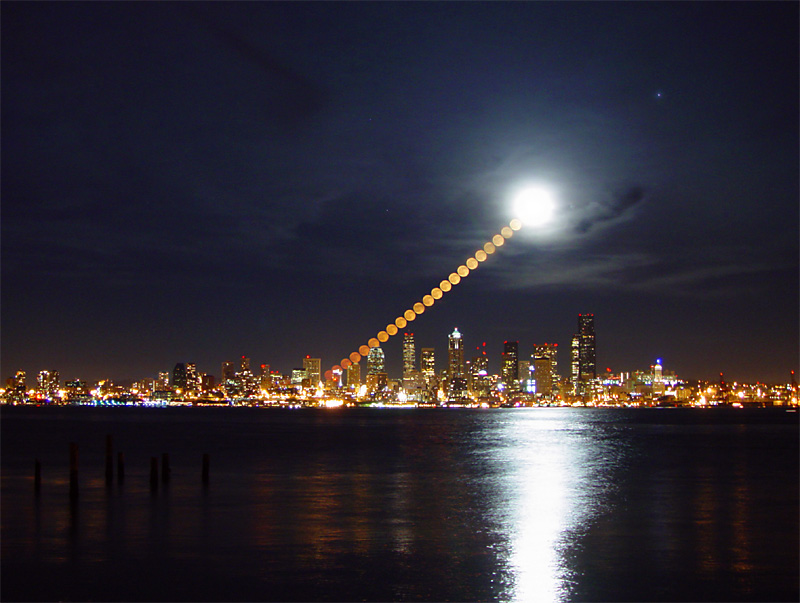
As shown in the photo the size of the Moon does not change. The picture does not detect changes so it is something that is in our head. Another example that we can not always rely of "reality" . So ruled the physical and atmospheric distortions just conceivable that this is an optical illusion of some sort. Our brain does not perceive either the distances and deceive us about the real size.
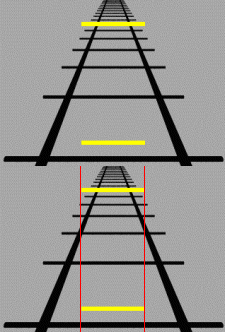 The first candidate is the Ponzo illusion
  . In this illusion we interpret that the horizontal lines have different dimensions because we are deceived by the converging lines around them. Proponents argue that trees, roads and other landscape elements create the same effect as the lines of the image. Another theory holds that can explain this fact based on the "Law of Emmert. " According to this theory the objects which occupy the same size image on our retina are adjusted in size to our brain in terms of perceived distance. However, these theories have a problem, airline pilots away from any reference point have reported the same illusion. Nor are the unique and Wikipedia entry includes a few more explanations.
 A final theory that is beginning to gain support focuses on the muscles of our eyes. When we look at an object, small muscles moving the eyeballs to converge on it. The brain is helped by this movement to calculate the distance to meet and, somehow, this calculation seems to fail when the moon or the sun approach the horizon. One item that seems to support "The representation of Perceived angular size in human primary visual cortex"
(pdf format) was published in Nature on February 5 this year. The experiment used nuclear magnetic resonance equipment to study how visual information processing. You can read more detailed explanations (and complex)
here. In any case, while it reaches a consensus on the issue, it is fascinating to observe how the mere sight of Luna continues to inspire science. PS: Many thanks to Jack for suggesting this topic and give me the link to the article
NASA. Category: Biology


0 comments:
Post a Comment